
Subaortic Stenosis in Dogs
Important information for dog owners
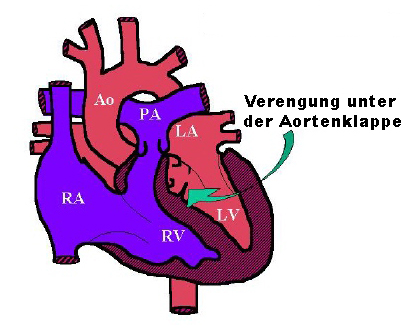
Subaortic stenosis (SAS) is a common congenital heart disease in dogs. In this condition, the narrowing is not directly at the aortic valve itself but below the aortic valve in the left ventricular outflow tract.
As a result, the left ventricle must pump blood into the aorta against increased resistance. The more severe the narrowing, the greater the pressure overload on the heart.
On this page you will find information about causes, symptoms, diagnosis, prognosis, and current treatment options. The specialized interventional treatment with a cutting balloon is described on a separate page.
What is aortic stenosis and what is subaortic stenosis?
Aortic stenosis refers to narrowing in the outflow region of the left ventricle. Depending on the exact location, three forms are distinguished:
- Valvular aortic stenosis – narrowing at the aortic valve itself
- Subvalvular aortic stenosis – narrowing below the aortic valve; this is the classic SAS
- Supravalvular aortic stenosis – narrowing above the aortic valve
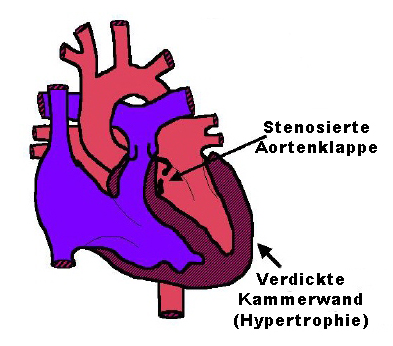
In dogs, the most important and most common form is subaortic stenosis. In many patients, this is caused by a fibrous or fibromuscular ridge or ring-like narrowing below the valve.
Which breeds are more commonly affected?
In principle, SAS can occur in different breeds, but some breeds are affected more often.
Commonly affected breeds:
Newfoundland, Boxer, German Shepherd Dog, Rottweiler, Golden Retriever
Mixed-breed dogs and other breeds can also be affected.
What symptoms can occur?
Many dogs with mild or moderate SAS appear normal for a long time. In young dogs, the disease is often first suspected because a heart murmur is detected during a routine examination.
In more advanced cases, the following signs may occur:
- fatigue
- reduced exercise tolerance
- shortness of breath
- collapse or fainting episodes (syncope)
- irregular heart rhythm
- rarely sudden cardiac death
Clinical signs usually suggest a more advanced or severe disease.
Why can SAS be dangerous?
The more severe the obstruction, the greater the pressure overload on the left ventricle and the higher the risk of complications.
Particularly in very severe cases, the risk of arrhythmias, syncope, and sudden cardiac death can increase substantially.
Dogs with very high pressure gradients therefore require especially careful cardiology follow-up and often an early treatment discussion.
How is the disease first detected?
In many dogs, the first clue is a heart murmur heard during vaccination or a routine physical examination. Especially in mild or moderate cases, the murmur can be relatively soft.
That is why heart murmurs in young dogs should always be evaluated carefully. Not every murmur means severe heart disease, but SAS should be reliably ruled out.
Which tests are important?
A full cardiac evaluation usually includes:
- physical examination and auscultation
- ECG
- thoracic radiographs
- echocardiography with Doppler as the most important test
ECG and radiographs may provide supportive information, but the most important test for diagnosis and grading is echocardiography.
What does echocardiography show?
Echocardiography allows the narrowing below the aortic valve and its effects on the heart to be assessed. In moderate to severe cases, one typically sees a thickened left ventricle as a consequence of chronic pressure overload.
Doppler ultrasound is especially important because it measures blood flow velocity across the obstruction. From this, the pressure gradient can be calculated.
How is severity classified?
Severity is usually classified according to the Doppler-derived pressure gradient.
Mild: less than 50 mmHg
Moderate: 50–80 mmHg
Severe: more than 80 mmHg
Particularly critical: more than 130 mmHg
Mild cases often have a good prognosis. In severe and especially very severe cases, the risk of serious complications rises significantly.
Prognosis
Prognosis depends mainly on the severity of the obstruction.
Mild and many moderate cases often have a favorable prognosis. In severe cases, prognosis is more guarded.
An important point is that more recent studies suggest dogs with a pressure gradient above about 130 mmHg have a substantially increased risk of sudden cardiac death.
For that reason, we evaluate very severe cases especially carefully and discuss early whether medical treatment alone is sufficient or whether an interventional approach should also be considered.
Medical treatment
Treatment depends on severity, clinical signs, arrhythmias, and secondary cardiac changes.
The goal of medical treatment is mainly to control heart rate, reduce myocardial oxygen demand, and lower the risk of clinical events.
In the past, atenolol was commonly used. Today, in many patients we more often use sotalol, especially when arrhythmias are also a concern.
The best medical plan always depends on the individual dog’s cardiology evaluation.
Interventional treatment
Simple balloon dilation with conventional balloons has shown only limited benefit in SAS and is not routinely recommended as a standard treatment.
However, in very severe cases, especially when the pressure gradient is extremely high or expected to continue to rise, a specialized cutting balloon intervention may be considered.
More information is available on our dedicated treatment page: Cutting balloon intervention for subaortic stenosis
When should a heart murmur be evaluated?
Any newly detected heart murmur in a young dog should be assessed carefully. Congenital diseases such as SAS may initially be clinically silent.
Early cardiology evaluation helps determine severity correctly and identify higher-risk patients in time.
Breeding examinations
Because subaortic stenosis is a congenital disease, cardiology screening before breeding is especially important in predisposed breeds.
Breeding examinations are typically performed when a dog is about one year old.