
Doberman Cardiomyopathy
An especially important heart disease in this breed
Doberman cardiomyopathy is a special form of dilated cardiomyopathy (DCM) that occurs very commonly in Doberman Pinschers. A characteristic feature is that the disease may remain occult for a prolonged period.
During this phase, many dogs still appear clinically normal but already develop ventricular arrhythmias. For that reason, early detection is especially important in this breed.
If you are looking for information about our scientific work and participation in our long-term study, please visit our Doberman cardiomyopathy project.
Why is Doberman cardiomyopathy so dangerous?
Many affected dogs initially have no symptoms, but they may already be at increased risk of serious arrhythmias and sudden cardiac death.
The disease typically begins with an occult phase in which ventricular premature complexes and other arrhythmias occur. Only later do many dogs develop systolic dysfunction, cardiac enlargement and congestive heart failure.
Disease progression
In most cases the disease starts with ventricular premature complexes (VPCs or VES). During this occult phase, echocardiography may still look normal or only mildly abnormal.
Some affected Dobermans die suddenly already during this phase, usually because of severe ventricular arrhythmias.
If the disease progresses further, the heart later develops left ventricular systolic dysfunction, chamber enlargement and frequently signs of left-sided congestive heart failure, especially pulmonary edema.
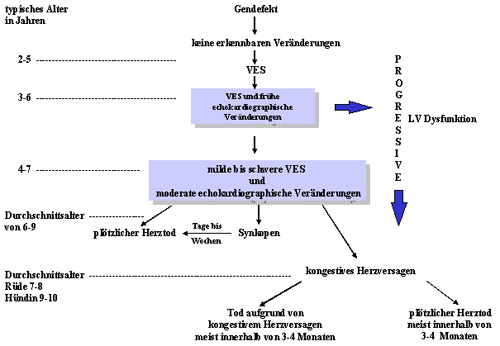
VES / VPCs = ventricular premature complexes
Syncope = fainting episode
LV dysfunction = reduced left ventricular pump function
How common is the disease?
Doberman cardiomyopathy is very common in Europe. In a study from our group, the prevalence was about 58.7%. This means that a large proportion of Dobermans develop the disease during their lifetime.
Risk increases substantially with age.
| Age group | Affected |
|---|---|
| 1 to < 2 years | 3.3% |
| 2 to < 4 years | 9.9% |
| 4 to < 6 years | 12.5% |
| 6 to < 8 years | 43.6% |
| ≥ 8 years | 44.1% |
These numbers underline why regular cardiac screening is so important in this breed.
What causes Doberman cardiomyopathy?
The disease is considered very likely to be genetically determined. In Dobermans, a classic nutritional deficiency such as may occasionally contribute to DCM in some other breeds usually does not play a major primary role.
The condition is regarded as inherited. That is why both early detection and responsible breeding screening are important.
Which symptoms can occur?
Dogs in the occult phase often have no obvious symptoms. Even so, dangerous arrhythmias may already be present.
In the symptomatic phase, signs may include:
- cough
- reduced exercise tolerance
- decreased activity and stamina
- increased resting respiratory rate
- shortness of breath
- syncope
- arrhythmias
- sometimes ascites or right-sided heart failure
- sudden cardiac death
Does hypothyroidism cause DCM?
Based on current scientific evidence, there is no proven causal relationship between hypothyroidism and classic Doberman cardiomyopathy.
Thyroid hormone treatment should therefore only be used when true hypothyroidism has been clearly diagnosed.
Early detection is essential
The main goal is to identify affected dogs before heart failure or sudden cardiac death occurs.
The most important tests are Holter monitoring and echocardiography. These two examinations complement each other and ideally should be performed regularly in Dobermans.
Screening examinations
Because the disease is so common, we generally recommend regular cardiology screening in clinically healthy Dobermans from about 2 to 3 years of age, usually once yearly.
Depending on age, family history, breeding plans and previous findings, shorter intervals may also be appropriate.
Holter monitor or 24-hour ECG
Holter monitoring is a central part of early detection in the Doberman. It records the heart rhythm continuously over 24 hours or longer while the dog is in its normal home environment.
It is especially important during the occult phase because many affected dogs first develop ventricular arrhythmias before showing obvious clinical signs.
Based on our data, more than 50 VES/VPCs in 24 hours is considered abnormal in Dobermans. Because occasional ectopy may also occur for other reasons, repeated recordings are often used to confirm the diagnosis.
Particularly suspicious: > 100 VES/VPCs in 24 hours, couplets, triplets or ventricular tachycardia
Typical in affected dogs: often several hundred to several thousand VES/VPCs in 24 hours
Short ECG
A routine ECG records only a short time period and is therefore not sufficient by itself for early screening.
However, if even a single ventricular premature complex is seen during a short ECG or during echocardiography, a Holter examination is usually indicated.
Echocardiography
With echocardiography we assess heart size and pump function. Moderate and severe abnormalities are often relatively easy to identify, while mild early changes are more difficult.
In Dobermans, studies from our group established important reference values and evaluated modern methods for earlier detection. In particular, the Simpson method can help detect early chamber enlargement and systolic dysfunction sooner than M-mode alone.
M-mode reference values in Dobermans:
Males: LVIDd > 48 mm, LVIDs > 36 mm
Females: LVIDd > 46 mm, LVIDs > 36 mm
Radiographs
Thoracic radiographs are less sensitive for early detection, but they can provide very important information when dogs already have symptoms such as cough or breathing difficulty.
They are especially useful to detect pulmonary edema, left atrial enlargement or other signs of congestion.
Biomarkers
Biomarkers can be helpful as additional tests, but they do not replace Holter monitoring or echocardiography.
In Doberman cardiomyopathy, we especially use cardiac troponin I and NT-proBNP.
Both markers may be elevated in some dogs before Holter or echocardiography becomes clearly abnormal. They are therefore useful supportive tests, but not stand-alone diagnostic tools.
Troponin I
Cardiac troponin I (cTnI) is released when heart muscle cells are damaged. Studies from our group showed that cTnI may already be increased in some Dobermans before later abnormalities become evident on Holter recordings or echocardiography.
NT-proBNP
NT-proBNP is a marker of cardiac stress. It can be elevated in dogs with heart failure and also helps distinguish cardiac from non-cardiac causes of dyspnea.
It can also be useful as an additional screening test in occult Doberman cardiomyopathy.
Video about the disease
Here you can find a video about Doberman cardiomyopathy with detailed information and interview.
Treatment of systolic dysfunction
When systolic function is reduced, pimobendan is now a key part of treatment.
Pimobendan improves contractility and also has vasodilatory effects. It is a central part of therapy for many Dobermans with reduced systolic function.
The PROTECT study showed that pimobendan can already be beneficial in the occult stage when echocardiographic abnormalities are present, prolonging the time until onset of congestive heart failure.
Treatment of ventricular arrhythmias
Treatment of arrhythmias is especially important when sustained ventricular tachyarrhythmias, syncope or other markers of increased rhythm risk are present.
Main goals of therapy include:
- reducing the risk of sudden cardiac death
- preventing ventricular tachyarrhythmias
- substantially reducing the number of VES/VPCs
- improving clinical signs
Commonly used drugs: sotalol, amiodarone, mexiletine, flecainide; in emergencies lidocaine intravenously.
Treatment of chronic heart failure
When chronic congestive heart failure is present, treatment usually includes several components:
- diuretics such as furosemide or torasemide
- pimobendan
- ACE inhibitors
- when needed digoxin, especially in atrial fibrillation
- control and treatment of arrhythmias
- in refractory cases additional diuretics such as thiazides or spironolactone
Treatment is always individualized based on findings, symptoms and the rhythm status of the patient.
Treatment of acute heart failure
In acute congestive heart failure, furosemide is one of the most important emergency drugs. Depending on the individual case, additional intensive care measures may be necessary, including intravenous positive inotropes such as pimobendan or dobutamine.
Prognosis
Prognosis depends strongly on disease stage, arrhythmia burden and response to treatment.
Even during the occult phase there is already a relevant risk of sudden cardiac death. Once clinical signs of heart failure appear, prognosis is usually more guarded.
At the same time, Dobermans with well-controlled arrhythmias may in some cases live for years. Early diagnosis and carefully tailored therapy are therefore especially important.